

MANSFIELD – The Ohio State University Mansfield will host “Research Frenzy” at Idea Works on Wednesday, Nov. 13, from 5 p.m.
The event, which is free and open to the public, will feature research experts from a wide range of fields, from psychology to biology, history to art. Experts discuss research related to narcissism, infectious diseases, wetlands, and more.
“Research Frenzy is an event where faculty and students come together to share the latest research,” said Dr. Amy Brunelle, professor in the Department of Psychology, organizer of this year’s Frenzy. “Similar to a TED Talk, participants highlight their work, but only have a few minutes before moving on to the next presenter.”
Research theme:
“How Disasters Strike: Modeling Epidemics in American History” by Dr. Jason Opal, Dean and Director of The Ohio State University Mansfield. “Why did yellow fever kill 10% of Philadelphia’s entire population in 1793? Why did cholera, which is native to the Ganges River, terrorize parts of rural Ohio and Indiana in the 1840s? And how did New York City escape a smallpox epidemic in 1947? My research draws on traditional historical sources and epidemiology, urban planning, as well as biology and zoology. By combining this information, we hope to answer these questions and help prevent future epidemics.”
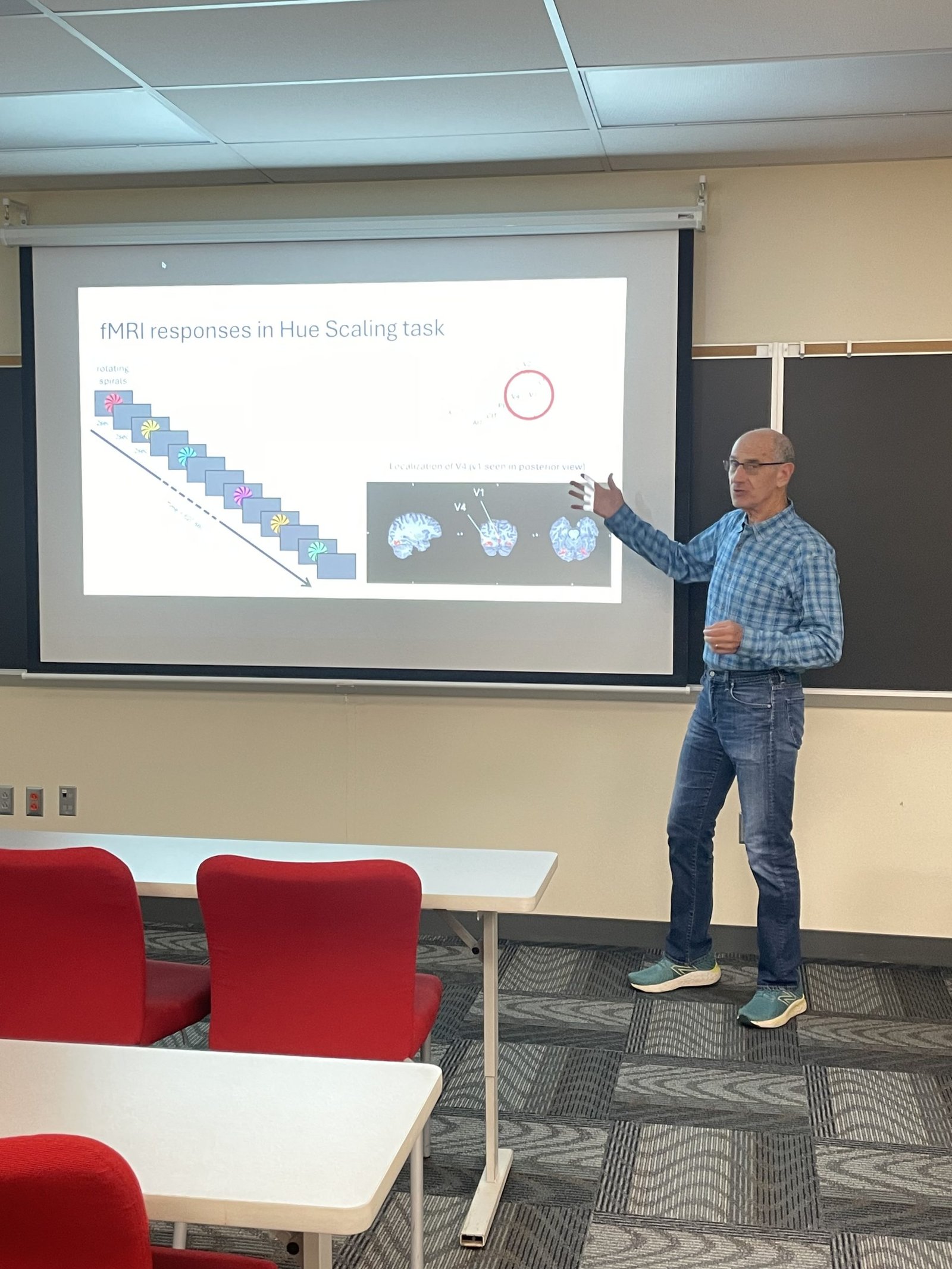
Functional magnetic resonance (fMRI) imaging of human brain responses related to color perception by Dr. Delwyn Lindsey, professor in the Department of Psychology. “fMRI is a technology that allows neuroscientists to observe and measure changes in brain activation as humans perform mental tasks. Basic color concepts such as red, green, blue, and yellow. We describe an fMRI study of brain regions involved in human understanding of color.What is interesting about our results is that the brain regions involved in color perception are the same as those in which human subjects actively judge how colors appear. It signals the elemental concept of color only when it is viewed passively, and not when it is passively looking at stimuli of the same color.
Sounds galore! ‘The Effects of Man-made Noise in Wetland Habitats’ by Senior Instructor Dr. Adrian Hopson. Department of Biology. “Soundscapes are defined as the composition of natural and man-made sounds in a habitat, and these are important but understudied aspects of most ecosystems. and how man-made sounds interact with natural sounds, changing the soundscape and affecting the animals that use it.”
Overcoming Narcissistic Relationships in the Workplace: What Can Organizations Do? Written by Amy B. Brunel, Ph.D., Professor of Psychology. “In the workplace, narcissists engage in counterproductive work behaviors such as counterproductive behavior in the workplace, bullying, and even white-collar crime. The results are particularly poor.In my talk, I will cover strategies that I believe are effective for overcoming narcissism in the workplace.
Communal narcissism and social-emotional skills in college students, by psychology student Autumn Meigs. “Communal narcissism refers to a form of narcissism characterized by an emphasis on appearing caring, altruistic, and morally superior. This study investigated the extent to which students with communal narcissism report social-emotional skills (e.g., self-regulation, social awareness, interpersonal skills). ”
When This You See, Remember Me by Kate Shannon, MFA Associate Professor, School of Fine Arts. “Through my presentation, I will share my experience curating a photographic exhibition of 19th century American portraits from the Floyd and Marion Linhart collection at The Ohio State University Rare Book and Manuscript Library. I would like to reflect on the enduring emotional and historical significance of these photographs, examining themes of memory, preservation, and the evolving role of photography in our lives.
How do animals budget? Dr. Agus Muñoz García, Associate Professor in the Department of Evolution, Ecology and Biological Biology. “Have you ever wondered how animals ‘decide’ how to use all the resources they get from their environment? They ‘feel’ the environmental conditions and control which cells and which organ’s activity increases or decreases. There are several proteins that can. As a result, resources are used for different tasks, such as finding food and water or making babies. These patterns of resource allocation according to the environment determine the survival and reproduction options of organisms. ”
Your Metal or Your Life: Why You Should Consider Metal Mining Seriously Dr. Kent “Kip” Curtis, Associate Professor in the Department of History. “This study of metal mining and production in the 19th and 20th centuries shows that raw material abundance has been the central mission of modern mining since the 1890s and of modern nations since World War I. It would be argued that the abundance and relative affordability of iron, copper, zinc, and lead (and dozens of other metals and alloys) led to a growing desire for and dependence on metals from old to new. facilitated the creation of a “technosphere” (a constructed world of human habitation). As we face new mining challenges in the transition to green energy, I propose a vision for “sustainable” mining. ”
Moai of Rapa Nui (Easter Island), Dr. Tim M. Vella, Academy Professor and Professor Emeritus of the Department of Evolution, Ecology and Organisms. “This talk will explain when and how Polynesia was settled, and where Rapa Nui fits into the last human diaspora. The talk will focus on the Moai at Rapa Nui, and explain why they were built. I will explain what happened, how big it was, and how it was carried out. I will also touch on why Rapa Nui society collapsed. Was it “ecocide” or “genocide”? ? ”
“Research Frenzy” is free and available to the public. Idea Works is located at 144 W. 3rd St. Mansfield, Ohio. For more information, contact Amy Brunell at brunell.2@osu.edu or 419-755-4119.
About The Ohio State University Mansfield
The Ohio State University Mansfield offers a Big Ten-level education with personalized attention on a small campus. Ohio State Mansfield is committed to academic excellence and community engagement, providing students with the knowledge and skills they need to succeed in their careers and contribute to their communities.
