

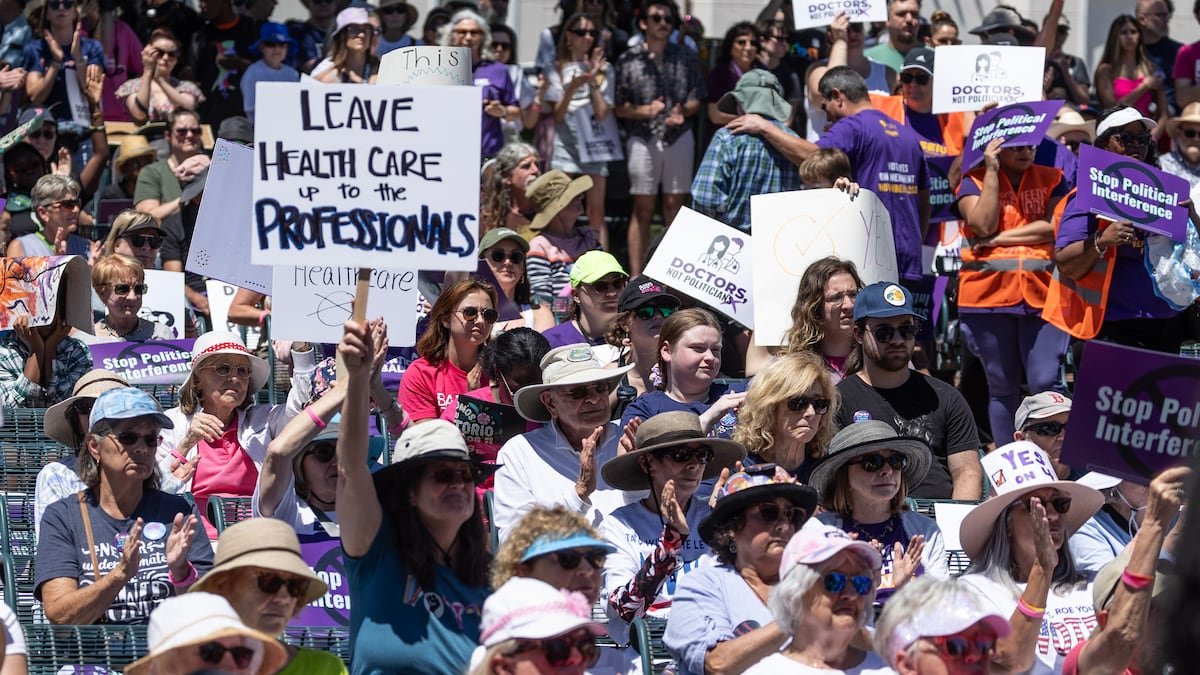
Gov. Ron DeSantis’ administration released an unprecedented report Friday accusing organizers of Florida’s abortion amendment of “extensive petition fraud” to gain control on next month’s ballot.
An unusual 348-page preliminary report by the Florida Secretary of State argues that the state Legislature should change the law to control future petition activity. And it could lay the groundwork for the administration’s attempt to disqualify or nullify the amendment, which Mr. DeSantis has vowed to veto.
The report alleges that organizers of the Fourth Amendment, which would overturn the state’s six-week abortion ban, illegally paid circulators based on the number of signatures they collected. The state reportedly fined organizers $328,000 on Friday.
The state audit estimates that 16.4% of petitions statewide should not have been approved, the report said.
The report also contains sweeping generalizations about the petition campaign, without providing supporting data.
Amendment 4 was sponsored by groups such as Floridians Defending Freedom and the American Civil Liberties Union of Florida, which plans to challenge the fine. Yes on 4 campaign director Lauren Brenzel denied any wrongdoing.
“This campaign was conducted in strict accordance with state law at every turn,” Brenzel said in a statement. “What we are seeing now is nothing but unjust interference and a desperate attempt to silence voters.”
Brenzel noted that the state had the opportunity to challenge the signature in January but did not.
The report, issued after Floridians began voting, is the latest example of the governor using state power to defeat Amendment 4, one of his top priorities this fall.
The state Department of Health Services last month launched a website opposing the proposed amendment, saying it could violate state law banning state-sponsored electioneering. On October 3, the general counsel for the state Department of Health issued cease-and-desist letters to television stations in Tampa and Gainesville, threatening criminal action if they refused to remove political ads supporting Amendment 4. Sent.
A report like the one released Friday has never been produced since DeSantis and Congress created the Office of Election Crimes and Security in 2022, and critics questioned the timing of the release.
The report says it was prepared “in advance of the next Congress” to “summarize preliminary findings and re-emphasize the need to more effectively regulate the circulation of petitions.”
The address was DeSantis, Senate President Kathleen Passidomo (R-Naples), and House Speaker Paul Renner (R-Palm Coast).
Congress doesn’t start until March. It will not be known until November’s election which members will be sworn in during the session. Mr. Renner will no longer be a member of Congress next year due to term limits, and Mr. Passidomo will no longer be president of the Senate.
State Rep. Anna Eskamani (D-Orlando) said it was “clear” the purpose of the report was not to provide information to state lawmakers.
“This is an attempt to mislead and confuse voters about three weeks before the election,” Eskamani said. “They are sending the report to the lame-duck chairman and the president of the Senate.”
To get on the ballot before voters next month, Fourth Amendment advocates have collected nearly 900,000 verified signatures from registered voters, needed in at least half of Florida’s 28 congressional districts. required a certain number of signatures.
The report says these petition campaigns have historically been rife with examples of fraud. Instead of doing the hard work of roaming parking lots and public spaces to garner legitimate support, circulators illegally make up names and forge voter signatures.
County election officials collect petitions, match voter information and signatures with what they have on file, and typically discard about 30% for a variety of reasons, including possible fraud.
Critics suspect that Mr. DeSantis’ office is targeting Fourth Amendment petition efforts for political reasons. The 2021 campaign, which was funded by Las Vegas Sands, whose late Sheldon Adelson was a major donor to DeSantis and the Republican Party, had more obvious signs of wrongdoing. But observers say the study failed because only the lowest-ranking circulators were investigated.
It is not clear why the state focused on Amendment 4 over other amendment efforts. The report says regulators reported an “unusually high volume of complaints” to the state, but the report does not compare the volume of complaints to other petition drives.
The report states that “a significant number of known and suspected fraudsters have counted petitions across the state,” but does not compare this to other petition drives.
The report cites an anonymous subcontractor who claims some of the circulators are paid for each signature, a third-degree felony, and one subcontractor who claims that some circulators are paid for each signature, a third-degree felony. It is mentioned that they advertised that they would be paid for each signature. The California-based company hired by the campaign has run several successful petition drives in Florida since the 1990s, but denies paying people for each signature.
Four circulators working on behalf of the amendment were arrested, in part after campaigns or election supervisors alerted authorities to concerns. This year, five other petition circulators were also arrested.
The state’s investigation included knocking on voters’ doors and asking if they would sign petitions, as well as requesting tens of thousands of petitions that regulators deemed valid. Election officials said they could not recall the state requesting a valid petition for a fraud investigation.
The state analyzed 13,445 verified petitions from Orange, Osceola and Palm Beach counties and found that at least “2,849 had legal deficiencies or obvious discrepancies between the petition signature and the signature on file.” “should not have been verified due to discrepancies,” the report said. .
The office estimated that in six Congressional districts, regulators improperly verified 11.7% to 23.6% of abortion petition signatures. Statewide, that rate could be 16.4%, which would have been enough to defeat the amendment in four districts, the report suggests, according to a Times/Herald analysis. I am doing it.
The report does not have data to compare these rates to other petition activity.
“The misconduct outlined in this report is unacceptable, and it is imperative that the state consider significant reforms to its initiative petition process to prevent groups from engaging in this type of behavior again in Florida.” ,” the report states.
The report says supervisors in Orange and Palm Beach counties “failed in their statutory duty to verify the petition” in accordance with state law.
Orange County Elections Director Christopher Heath said his office is “aware of the report and is reviewing the findings.”
A spokeswoman for Palm Beach County Supervisor Wendy Sartree Link did not respond to a request for comment Saturday.
