

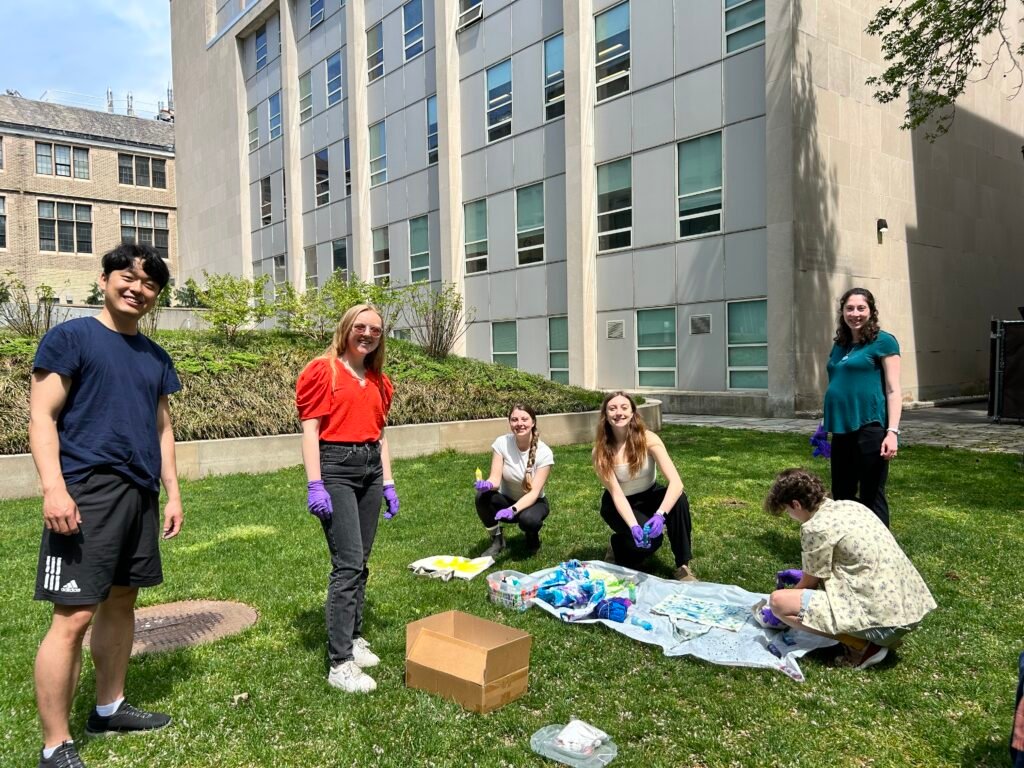
The News spoke to members of Yale University’s Winter Lab about their research on developing sustainable electrification processes for climate, food, energy, and water.
Emily Kim October 14, 2024 11:29pm
staff reporter
Provided by Kim Ji-young
Yale University’s Winter Lab is part of the Department of Chemical and Environmental Engineering and studies electrification processes in food, energy, climate, and water.
As the transition to clean energy gains momentum, the Winter Lab combines two separate methodologies that are typically studied separately: electrocatalysis and nonthermal plasma. This new approach helped develop a more sustainable electrification process. The research team recently published their first research paper in the journal Nature Water.
“We have developed a new electricity-based water treatment platform, or ‘charged membrane,’ by making the membrane conductive,” said Lee Winter, assistant professor in the Department of Chemical and Environmental Engineering. “This allows us to convert contaminants into harmless forms or useful products, rather than simply separating them from the water and creating a hazardous concentrated waste stream.”
Winter hopes his lab can focus on innovative solutions that reduce the environmental impact of chemical manufacturing and increase access to water and food.
The Winter Lab’s projects include research into chemical methods to convert CO2 in the ocean into sustainable fuels. Undergraduate assistant Eric Chen ’26 told the News that the Winter lab is excited about the increase in CO2 reduction research.
“While our research is still small and theoretical at this point, it has the potential to have a major impact on energy and water treatment,” said Anna Oehler-King ’25, another undergraduate assistant. said. “We’re excited about the potential impact it could have on small-scale water treatment. These processes are more affordable and use less energy, so this type of system could be used on a larger scale. It could one day be deployed in low-income areas of the world without requiring the installation of major water infrastructure.”
Winter Lab researchers joined because of the lab’s circular economy approach to sustainable development and innovation.
“I think Professor Winter’s research approach is very applicable to the current economic and global situation,” Chen said. “As society transitions to clean energy, the question remains what needs to be done with existing waste and waste that may be generated in the future.”
Postdoctoral fellow Jiyoung Kim also joined the lab because of Winter’s unique approach to sustainable development research. Kim was interested in the intersection of electrocatalysis and nonthermal plasma, Winter’s area of expertise.
For both undergraduate and graduate students, the Winter Lab is more than just a research space.
“I’m really grateful that my lab experience goes beyond just research and leads to the formation of a community that supports each other,” Oehler-King said. “I am so grateful for all the support I have received.”
The team tries out new snacks at each group meeting and holds lab networking events such as pickleball games. The Winter Lab also features pastel-colored centrifuge tubes and colorful frames of safety glasses.
Kim told the News in Korean that her favorite social interaction in the lab was wearing a tie-dye lab coat.
“This tie-dyed lab coat is a symbol of our laboratory,” Kim told the News in Korean. “Normally lab coats are white, but our lab coats are very flashy. People sometimes call us ‘mad scientists’ because of our tie-dyed lab coats.”
For Kim, participating in the Winter Lab was a new social experience. Kim, who grew up in South Korea and attended Seoul National University, said his previous lab was made up of mostly male researchers. Kim said he appreciates the diversity of people and social events at Winter Lab.
Yale School of Engineering and Applied Sciences is located at 17 Hillhouse Ave.
Emily Kim
Emily Khym covers transportation and infrastructure for the City Desk. As a production and design staff member, she also does layouts for printing paper. A native of Honolulu, Hawaii, she is a sophomore at Benjamin Franklin University majoring in political science and earning a certificate in energy studies.
